
Pre-harvest glyphosate
What you need to know before you buy
The question comes up at the counter every August, and it is a fair one. Glyphosate is glyphosate. There are a dozen jugs on the shelf at 540 grams of acid equivalent per litre, the active is off patent, and the cheapest one is meaningfully cheaper. Why would anyone pay more?
Ryan Adams, P.Ag., CCA, Head of North America Agronomy, Life Scientific explains that the honest answer has almost nothing to do with the active ingredient, and everything to do with what pre-harvest actually asks of a herbicide.
You are not spraying for this year’s crop
Let’s start with what the pass is for. A pre-harvest glyphosate application is registered for perennial weed control — quackgrass, Canada thistle, dandelion, toadflax, common milkweed, and season-long control of perennial sow thistle. This year’s crop has already been made, and your pre-harvest glyphosate pass won’t add a bushel.
This changes what “working” looks like. Fast, visible top-kill is not the goal — if the leaf dies before the load moves, the pass is wasted. Instead, the job is translocation.
Late in the season, perennials are pulling assimilate down into roots and rhizomes to overwinter. This is the one window of the year when a systemic herbicide can ride that flow to the places that matter. Success is measured next spring, in shoots per square metre, not in how the patch looks fourteen days after the sprayer leaves. What you are buying is a clean field next May.
There is a second job on the label: harvest management. Glyphosate dries down late weed flushes and green vegetative growth that would otherwise interfere with harvest. Green kochia, thistle or volunteer canola still standing when the combine arrives is hard on the header, hard to chop, and shows up in the sample. That is real, and it matters.
But it’s worth being precise here, because the benefits are often overstated. Glyphosate is not a desiccant. Cool, wet or cloudy weather after application can slow activity and delay dry-down. If dry-down speed is the actual objective, a true desiccant should be used.
The hardest timing of the year
Pre-harvest asks more of a formulation than any other pass. Everything is working against it:
- The leaf surface has changed - cuticles thicken and harden as the plant senesces.
- Nights are cool, which slows metabolism and translocation.
- Late-season fields are dusty, and dust on a leaf intercepts spray before it reaches the plant.
- Plants under drought stress translocate poorly.
- And the window is short — below 30% grain moisture in the least mature part of the field, typically seven to fourteen days before harvest, with the combine already booked and no realistic chance of a second pass.
Every one of those is a barrier between the nozzle and the rhizome. Getting across them is not the active ingredient's job, it’s the co-formulant system's job.
Three things have to happen
Readers who followed our fungicide series will recognise the framework, because it applies just as cleanly here:
Deliver — onto the plant. Droplets have to land and stay put on a waxy, hairy, dust-covered leaf instead of bouncing, shattering or running off. Surfactants control retention and spread.
Distribute — into the plant and through it. The active crosses a cuticle that thickens as the plant matures, then loads into the phloem and moves with the plant's own sugars.
Diffuse — to the site of action. It reaches roots, rhizomes and growing points, and into the cells where it works. Only then is the weed dead.
At pre-harvest, Diffuse is the job that pays. Fall short and your glyphosate may only do a half job — same rate, same cost of application, less result.
Where two 540s stop being the same
Here is the part that never makes the front label. An off-patent product is required to match the active ingredient, but it is not required to match anything else. The surfactants, the humectants, the water conditioners, the antifoam — the entire package that governs retention, uptake and translocation — is left to whoever built the formulation.
Two jugs can declare the same 540 grams of acid equivalent per litre, put the same amount of acid on the leaf, and deliver very different amounts to the rhizome. On a July fallow burn-off with a soft, actively growing weed, that difference may not show up. On a senescing crop in early September, it has every opportunity to.
This is the reasoning behind Life Scientific's approach. Rather than registering the active alone, we reverse-engineer the complete formulation profile of the reference product and rebuild it — every co-formulant included, down to the source of the chemistry.
What the analysis shows
Claims about formulation are easy to make and hard to check, so here is the data.
The chromatograms below compare GlyMax 540 against the premium industry standard benchmark product. Two complementary methods are involved. LC-MS — liquid chromatography–mass spectrometry — separates everything in the jug and weighs each component, so every co-formulant appears as its own peak. Proton NMR (Nuclear Magnetic Resonance) reads the molecular structure of what those peaks are. Run together, they identify not just how much of each component is present, but what each one actually is.
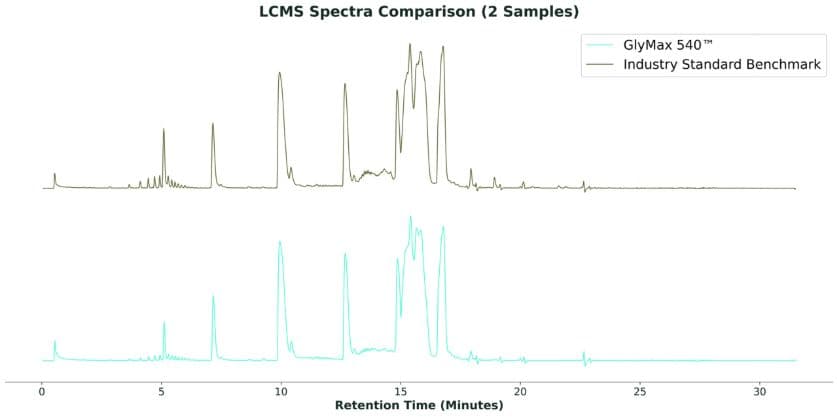
While this is not a guarantee of performance it does verify composition: the same components, in the same proportions, at the same retention times.
Getting the pass right, whatever is in the tank
None of the above matters if the application is mistimed, so it is worth restating the fundamentals. These apply to any pre-harvest glyphosate:
- Stage to the crop, not the calendar. Under 30% grain moisture in the least mature part of the field. The thumbnail test at hard dough is still the most reliable field check there is.
- Stage to the weed as well. Quackgrass actively growing with four to five green leaves. Canada thistle and perennial sow thistle at or beyond bud.
- Check the water. Hard water and high pH work against glyphosate, and carrier water quality is the most common unforced error in a pre-harvest pass.
- Watch the forecast. Rainfall soon after application can reduce control.
- Confirm your buyer before you spray. Some grain and pulse buyers will not accept pre-harvest-treated product. Malt barley buyers will not accept it — the crop is on the label, but the market will not take it. That distinction has cost growers real money.
Keep it Clean publishes updated guidance every season, and it is worth five minutes before the sprayer rolls.
The bottom line
Pre-harvest is one pass, on a crop that is already made, at the toughest timing of the year — and you don’t get to run it again. What you’re paying for in a jug of glyphosate is two things: the active, and the formulation package around it. The active ingredient is a commodity – every registrant meets the same standard. The formulation package is the one that deicides whether the product works and when it counts.
Same formulation. Fairer price.
GlyMax 540 (Registration No. 35747, Pest Control Products Act) is registered in Canada for pre-harvest use on 18 crops. Always read and follow the product label Life Scientific is not affiliated with, endorsed by, or sponsored by Bayer.