
The Green Patch Problem
What a Desiccant Can, and Can't, Do for You This Harvest
Harvest is underway across Western Canada, but not at the same pace everywhere.
In parts of northern Alberta and Manitoba, excess moisture through spring and early summer delayed crop development and drowned out low spots. Saskatchewan is more mixed, with many areas now dry, but later crops and localized wet pockets are still showing the effects of an uneven season.
From the cab, that lingering damage doesn't necessarily look like a wet field. It looks like a good crop with holes in it. Drowned-out low spots that never established a crop and are now green with kochia, foxtail barley, volunteers and whatever else found bare ground and moisture. Regrowth is pushing in from the edges, and staging canrun a week or more apart from the knoll to the bottom of the slough.
By mid-September later-seeded crops are still standing in many areas. In those fields, the problem becomes – how to deal with the green material when the rest of the crop is ready. What a drowned-out acre actually costs you
It's not only the lost yield in the drowned-out hole — that's already gone, and no harvest aid can bring it back. The additional cost comes from the weeds and green growth that moved into the open ground: Lost time. Tough, high-moisture stems slow the combine down, increase the risk of plugging and may force you to return for a second pass. When the harvest window is short, that lost time costs money. Lost quality. Green weed material and immature seed can increase dockage, cause staining and result in moisture pockets that show up later in the bin.
- Lost flexibility. The wettest part of the field sets the harvest date for the whole field unless you do something about it.
First, decide what problem you are trying to solve
A green patch can point to two different problems.
If the goal is to dry mature green material so the field can be harvested more efficiently, a desiccant may fit. If the goal is to control perennial weeds before next season, it does not.
Diquat is a contact product. It burns off the plant tissue it reaches, but it does not move down into the roots. Perennial weeds may dry down above ground and then return later in the fall or the following spring.
Controlling those roots requires a systemic herbicide, applied pre-harvest where the crop stage and buyer requirements allow it, or after harvest where they do not.
The costly mistake is asking one product to do the other product’s job: using a desiccant and expecting a cleaner field next spring or using a systemic herbicide to dry green material when the crop stage or buyer does not allow it.
What a diquat desiccant does, and how fast
DryQuat contains diquat ion at 200 g/L. It is a Group 22 contact desiccant registered for pulse, oilseed and legume forage seed crops: peas, lentils, chickpeas, faba beans, dry beans, soybeans, canola, mustard, flax, sunflowers, sweet white lupins and legume forage seed.
It's non-volatile, fast-acting, and inactivated on contact with soil, so there's no residual carried into next year. It's also absorbed rapidly enough that a rain shortly after treatment doesn't cost you the application — which is worth something in a season that hasn't handed anyone a clean stretch of weather.
For most crops, harvest can begin four to ten days later. In canola, pod and stem kill generally take seven to ten days. Cool, humid or late-fall conditions stretch that. Germination isn't affected, so pedigreed seed crops aren't a complication.
One interesting note: a cloudy day, or a pass made ahead of darkness, can improve the result rather than compromise it. The evening application is often the preferred option.
Overall, growers have flexibility around when to spray a desiccant, but not around how the product is used. A good result still depends on getting two things right: crop stage and coverage.
It does not mature the crop. It stops it.
A desiccant dries the green material that's already there. It does not advance physiological maturity. Applied early, it locks in whatever green seed is present at the time.
In canola, applying before 90% of seed has turned brown can put high green seed straight into the sample. In flax, wait until at least 75% boll turn. In peas, the bottom pods on most plants should be ripe and dry, with the seeds detached. Premature desiccation costs yield.
The other end of the window matters too. In canola and mustard, combine no later than 14 days after application, and get at standing desiccated canola as soon as it's fit. Pod drop and shattering losses climb with every day it stands, especially in wind and heavy rain.
It only works where it lands.
Diquat is a contact product. It does not move through the plant, so it can only try the plant tissue it reaches. That makes coverage central to the result.
For most registered crops, ground applications run 20 to 49 gal/ac of water. Aerial application requires at least 4 gal/ac. Spray quality must be no finer than medium, and boom height at 60 cm or less. Do not use mist blowers. Finally, use clean water — muddy water reduces effectiveness, which is a live risk in a year when the nearest fill is a slough that wasn't there in May.
The weedy patch needs its own plan.
Dense canopies and weedy crops call for the top of the rate range rather than the bottom. In a difficult pea field, the label calls for the top ground rate of 0.83 L/ac instead of the 0.61 to 0.83 range a clean, normal crop would get. In faba beans, the label goes further and asks for higher pressure with high-clearance sprayers, 90 to 100 psi, to improve coverage down into the lower stem. If this year's fields are giving you patches, that's the rate and pressure conversation to have before the sprayer rolls.
Which diquat, though?
Because diquat only works where it lands, the formulation around the active ingredient matters. Retention, spreading and coverage are not packaging around the chemistry. They help deliver the chemistry to the plant.
Two products carrying the same diquat ion load can behave differently on a waxy canola stem or a dusty lentil canopy if the co-formulant systems aren't built the same way.
One practical marker is the need for an added adjuvant. For on ground application, DryQuat doesn't require one. The wetting system is already in the formulation rather than something the grower is expected to supply at the tank.
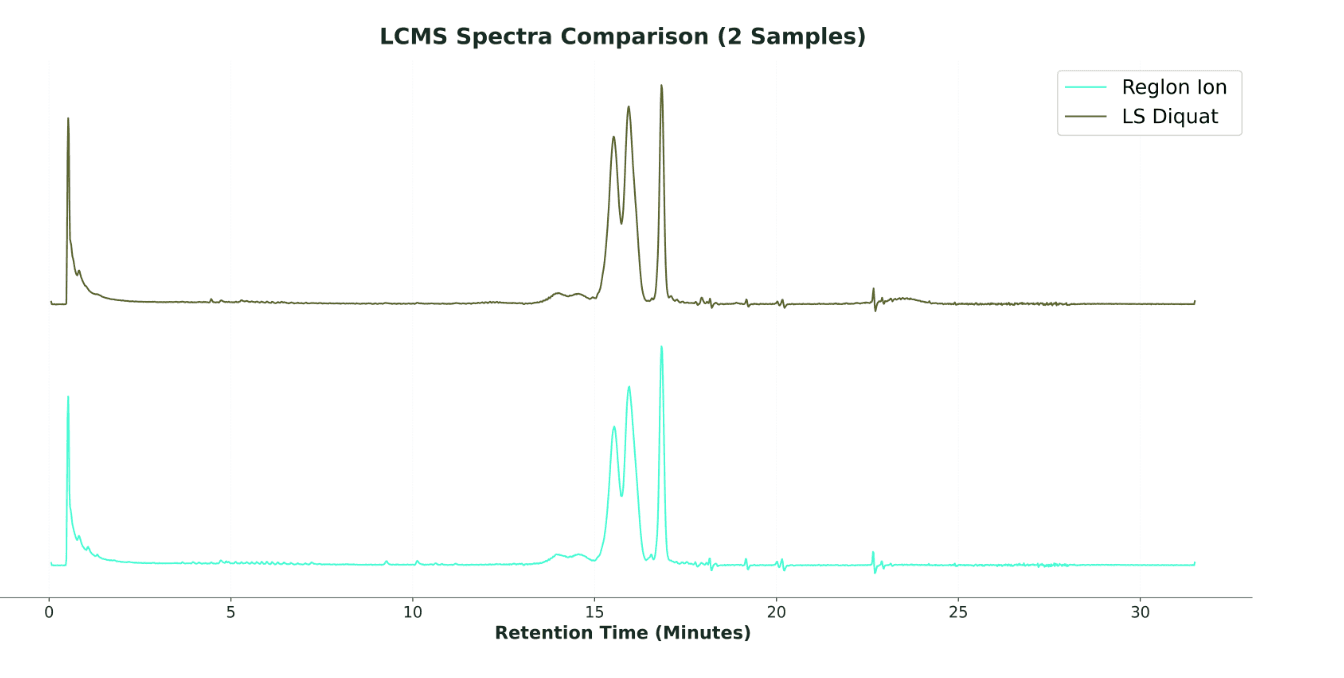
Life Scientific develops molecular replicas by examining the full formulation, not only the active ingredient. Below, DryQuat is overlaid against the reference diquat formulation by The LC-MS comparison below overlays DryQuat with the reference diquat formulation. It shows the same diquat ion load, same registered use pattern, and peaks that line up across the co-formulant region rather than only at the active ingredient.
The other question: what your buyer accepts?
Keep it Clean's 2026 Product Advisory works on a simple rule — if a product and crop combination isn't listed, no significant market risk has been identified, and the treated crop is accepted by most grain buyers.
Diquat doesn’t appear on the 2026 advisory for any of the crops it covers.
Pre-harvest glyphosate is treated differently. It's listed as registered for pre-harvest weed control and explicitly not as a desiccant. Buyers will not accept treated malt barley, while several pulse crops, oats, wheat, and food or feed barley carry instructions to consult the buyer first. And the timing rule, apply only below 30% grain moisture in the least mature part of the field, comes with a footnote that lands hard this year: secondary growth makes that assessment harder to get right.
Glyphosate remains the most important pre-harvest weed control product on the Prairies, and there are fields this fall where it's clearly the right call. The point is that glyphosate and diquat do different jobs and come with different market considerations.
Before you book the sprayer
The green patch does not make the decision for you. Before choosing a product, answer these questions:
1. Is the crop actually ready, or does it just look ready? Check the crop-specific stage on the label, in the least mature part of the field.
2. What's growing in the patch? Annuals you need dried, or perennials you need killed. Those are different products.
3. Does your buyer have anything to say about it? Check the current Keep it Clean advisory and your contract before the tank is filled, not after.
4. Are you set up for coverage in the worst part of the field? Water volume, spray quality, pressure, clean water, and the top of the rate range where the canopy is dense or weedy.
5. Which product — and can your supplier show you what's in it? The active ingredient matters, but with a contact product, the system carrying it to the plant matters too.
A desiccant can help get a mature but uneven field through the combine more efficiently. It cannot mature an unready crop, and it cannot replace systemic weed control. The right choice starts with being clear about which problem you are trying to solve.